JCRC and Makerere University will help develop, manufacture and test an affordable HIV cure through IMMUNEQUITY, a six-year programme led by Western University and funded by the Government of Canada.
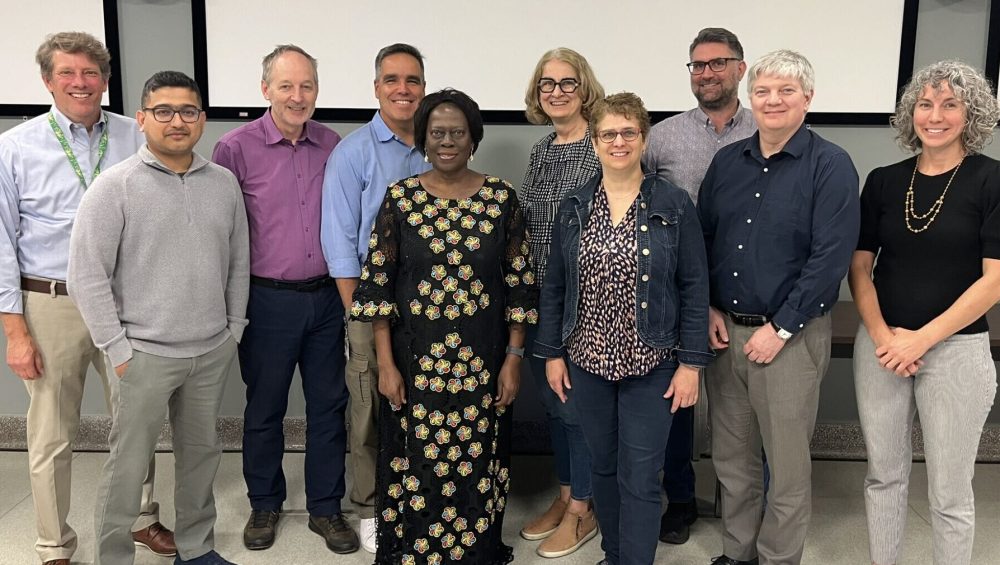
Photo: Core faculty members of the IMMUNEQUITY team. Dr. Cissy Kityo Mutuluuza (front centre), Ugandan HIV/AIDS researcher and executive director of the Joint Clinical Research Centre, visited Western in June 2025 for early planning meetings and to receive an honorary degree. Credit: Maria Drangova/Schulich Medicine & Dentistry.
The Joint Clinical Research Centre is part of an international team that has been awarded CAD 24 million by the Government of Canada to pursue a cure for HIV that is affordable and accessible from the start. The funding, announced on 23 October 2026 through the New Frontiers in Research Fund’s Transformation stream, supports IMMUNEQUITY, a six-year programme led by Western University in Canada with JCRC and Makerere University as Ugandan co-developers.
For JCRC, the award is a milestone in a decade-long partnership with Western and a strong endorsement of a conviction the Centre has held throughout its history: that scientific breakthroughs should reach the communities that carry the heaviest burden of disease, not decades later, but from the beginning.
For Uganda, this is the chance to prove an HIV cure works at home, working alongside Canada rather than years behind it.
“What makes this support so transformative is that it embeds health equity directly into the scientific process from day one,” said Dr Cissy Kityo-Mutuluuza, Executive Director of JCRC and a co-principal investigator on the programme. “We are not only pursuing an HIV cure; we are building the manufacturing, the diagnostics and the people in Uganda to deliver it.”
Designing the cure and its delivery together
IMMUNEQUITY pairs advanced immune therapies with what the team calls frugal biomedical innovation: manufacturing, diagnostics and cold-chain technology engineered to meet international standards at a fraction of the usual cost. It inverts the usual innovation sequence. Rather than discover a therapy, optimise it and only later ask whether it can scale, the programme treats access as a design criterion from the first day, engineering the cure and the means to deliver it in parallel.
The science follows a “kick and kill” strategy. A biotherapeutic agent wakes HIV that lies hidden in the body, and immune therapies, including antibody-producing cells and engineered natural-killer cells, clear it. Crucially for Uganda, these products are designed to be made in affordable, small-batch form, and the programme will establish good-manufacturing-practice production at JCRC.
Health sovereignty, not dependence
For JCRC, the deeper goal is what Dr Kityo-Mutuluuza calls health sovereignty: the capacity of a country and a region to protect its people when external support is uncertain, and to contribute science back to the world rather than only receive it. The programme is as much a development strategy as a scientific one, building manufacturing, regulatory and research capacity that outlasts the grant.
We are not building a cure for communities. We are building it with them.
What it means for Uganda
Over the six years, JCRC and Makerere will test cure candidates on samples from Ugandans living with HIV, tailored to the virus subtypes common in the region; develop low-cost, point-of-care tests to monitor the cure; establish local manufacturing; and prepare for first-in-human studies in Uganda alongside Canada. The programme will also train a cohort of Ugandan graduate students and early-career scientists, strengthening the country’s long-term capacity in cure science and biomanufacturing.
The partnership brings together Western University, the University of British Columbia, the University of Ottawa, Université de Montréal and the University of Manitoba in Canada; JCRC and Makerere University in Uganda; and the Toronto-based company SHC Therapeutics.
Read the Government of Canada and Western University announcements:
- Government of Canada announcement
- Western University announcement
- NFRF Transformation award recipients
About the Joint Clinical Research Centre (JCRC)
The Joint Clinical Research Centre is a Ugandan not-for-profit research institution established by the Ministry of Health, the Ministry of Defence and Makerere University College of Health Sciences. For over three decades JCRC has led clinical research and care in sub-Saharan Africa, pioneering antiretroviral therapy in the region, conducting some of the continent’s first HIV vaccine trials, and more recently establishing cell and gene therapy capability in Uganda. JCRC’s mission is to advance health through research, and to ensure that scientific breakthroughs reach the communities that need them most.